
Ecommerce SEO optimization is the systematic process of increasing an online store’s visibility in organic search results to drive qualified traffic and, ultimately, revenue. It combines technical architecture, keyword strategy, category and product page optimization, and internal linking. When executed correctly, organic search accounts for 23.6% of ecommerce orders at zero cost-per-click, making it the highest-margin acquisition channel available to most stores.
What is ecommerce SEO optimization and why does it drive revenue?
Ecommerce SEO optimization is the practice of improving an online store’s organic search visibility to attract buyers without paying for each click. It covers every layer of a store’s digital presence: technical infrastructure, site architecture, page-level content, and external authority signals.
The business case is direct. Organic search accounts for 53% of all website traffic and converts at an average rate of 2.8% for ecommerce stores. That conversion rate exceeds social media traffic and is cost-effective relative to paid search, with no cost-per-click eating into margin. Over time, a well-optimized store builds compounding organic revenue that does not disappear the moment an ad budget is paused.
The challenge is that 96.55% of all pages on the web receive zero traffic from Google (Ahrefs, 2026). Ecommerce stores with hundreds or thousands of product pages are especially exposed to this problem if they treat SEO as a secondary concern.
The core of ecommerce revenue growth is building traffic channels that scale without proportional cost increases. Organic search is the primary candidate, but only when the underlying SEO infrastructure is correctly built.
What are the technical SEO foundations every ecommerce store needs?
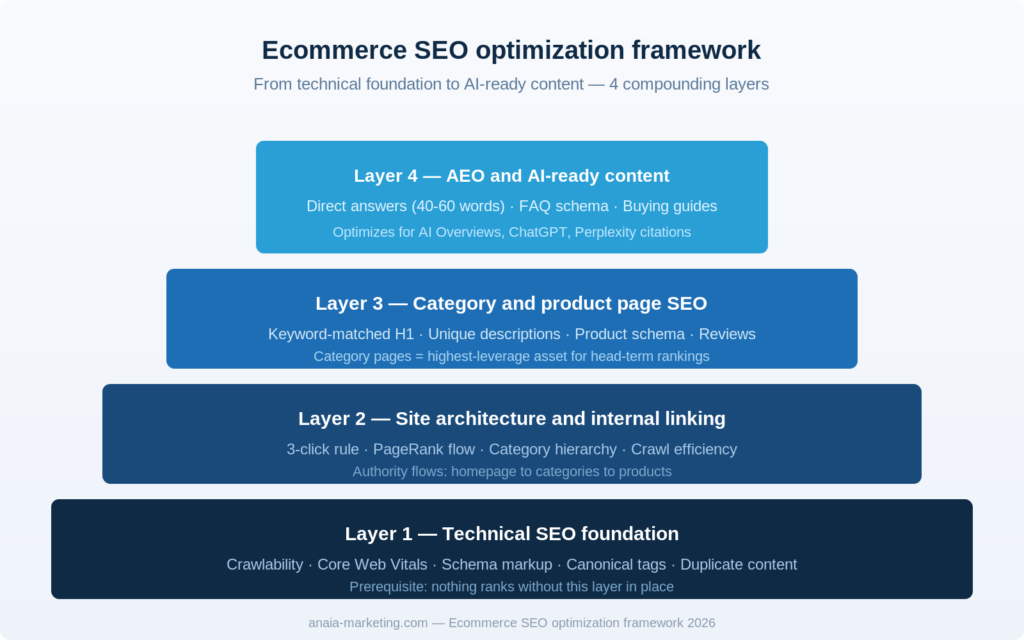
Technical SEO is the infrastructure layer that determines whether search engines can find, crawl, and index your store in the first place. Without it, no amount of keyword research or content creation delivers consistent results.
Crawlability and indexation
Large ecommerce stores with tens of thousands of URLs must actively manage crawl budget. When Google crawls low-value pages (filtered variants, empty search result pages, staging URLs), it wastes resources and delays indexation of category and product pages that actually drive revenue. A properly configured robots.txt, combined with canonical tags on variant pages, directs crawlers toward pages that matter.
Core Web Vitals
Page experience signals directly influence ranking and conversion. Largest Contentful Paint (LCP), Cumulative Layout Shift (CLS), and Interaction to Next Paint (INP) are the three targets to monitor. Mobile devices account for 51% of global platform market share as of May 2026, meaning slow mobile performance has a direct and measurable revenue cost.
Structured data
Product schema, BreadcrumbList, and FAQPage markup allow Google to surface rich results: price, availability, reviews, and breadcrumbs directly in search results. A product card with star ratings and stock status consistently generates higher click-through rates than a plain blue link for the same position.
Duplicate content
Ecommerce sites are inherently prone to near-duplicate URLs: color variants, size variants, filter combinations, and paginated pages all generate content that search engines treat as competing for the same ranking. Canonical tags resolve most cases, but a platform-level audit is necessary for any store with complex taxonomy or faceted navigation.
How do you optimize ecommerce category pages for organic traffic?
Category pages are the highest-leverage SEO asset in an ecommerce store. They target high-volume, broad-intent keywords and serve as the structural backbone of internal linking. Research from Reboot Online (2025) found that 86% of ecommerce brands fail to have properly optimized internal links on their category pages — a structural gap that directly suppresses ranking potential.
A well-optimized category page has five components.
First, a keyword-matched H1 that reflects how buyers describe the product set, not how the brand internally categorizes it. “Women’s running shoes” consistently outperforms internal naming conventions like “Footwear — Sport — Female.”
Second, an introductory paragraph of 150 to 300 words that signals topical relevance to crawlers while giving buyers context. This paragraph must include the primary keyword in the first sentence and distribute LSI terms naturally throughout.
Third, faceted navigation handled correctly. Filter parameters should either be canonicalized to the parent category or given their own indexable pages when they represent genuine search demand. “Women’s trail running shoes for wide feet” is a query worth targeting. “sort=price_asc” is not.
Fourth, internal links to top-selling products and adjacent category pages. Category pages should both receive and distribute PageRank.
Fifth, a validated BreadcrumbList schema so that Google can display the store’s navigation hierarchy in search results, improving click-through rates at zero incremental cost.
If your category pages are not driving the organic traffic your products deserve, the Anaia revenue growth diagnostic identifies exactly where the structure is breaking down. Run the diagnostic in under 15 minutes.
How do you optimize ecommerce product pages for SEO?
Product pages are where conversions happen. Their SEO role is to rank for specific, high-intent queries from buyers who know what they want and to convert that traffic at a rate higher than any other page type in the store.
The foundational elements are non-negotiable: the primary keyword belongs in the <title> tag, H1, meta description, product description’s first paragraph, and alt text of the primary product image.
Beyond the basics, three optimizations consistently move the needle.
Unique product descriptions. Manufacturer descriptions are replicated across hundreds of competitor sites. Rewritten, buyer-focused descriptions give Google a reason to prefer your page and give buyers a reason to convert. At minimum, the first 150 words must be original.
Product schema. Structured data communicates price, availability, SKU, brand, and aggregate rating directly to Google. Shopify’s ecommerce SEO guide identifies schema completeness as one of the top ranking factors for product pages. The majority of stores implement it partially or not at all, which is a direct competitive gap.
User-generated content. Reviews and Q&A sections add fresh, keyword-rich content to product pages without editorial effort. They signal trustworthiness to both search engines and buyers. A product page with 30 reviews consistently outranks the same product page with none, holding all other variables equal.
What is the right keyword strategy for ecommerce SEO optimization?
Ecommerce keyword strategy operates across three tiers, and most stores underinvest in the first two.
| Tier | Type | Example | Best-fit page |
|---|---|---|---|
| 1 | Head terms (1-2 words) | “running shoes” | Category page |
| 2 | Mid-tail (2-3 words) | “women’s trail running shoes” | Sub-category page |
| 3 | Long-tail (4+ words) | “waterproof trail running shoes wide fit” | Product page or buying guide |
Head terms drive volume; long-tail drives conversion intent. A store that only targets long-tail queries builds traffic that converts well but scales slowly. A store that only targets head terms competes with Amazon and major retailers from day one, with limited realistic potential to win on domain authority alone.
The right approach maps each keyword tier to its corresponding page type, then uses editorial content (buying guides, comparison articles) to capture informational intent and funnel buyers into category and product pages through contextual internal links.
How does internal linking affect ecommerce SEO performance?
Internal linking is the distribution mechanism for PageRank across a store’s page hierarchy. It determines which pages Google treats as authoritative within the site and which it treats as peripheral. For ecommerce stores, this is a critical dynamic because product pages rarely earn external links. They depend almost entirely on internal authority passed down from category pages and the homepage.
The structural principle is direct: authority flows downward from the homepage through category pages to product pages. Any page not reachable within three clicks from the homepage is effectively invisible to both crawlers and buyers.
Anaia’s work with ecommerce brands shows that a review of internal linking structure is consistently one of the fastest levers for recovering organic traffic. Not because new content is needed, but because existing pages are isolated from the authority they should be receiving. If your store is experiencing organic traffic gaps, diagnosing your ecommerce revenue leaks is the right starting point before investing in additional content.
How should ecommerce stores adapt to AI Overviews and AEO in 2026?
AI Overviews have reshaped the top of the search results page. Semrush data shows that AI Overviews appeared for up to 25% of queries mid-2025 before stabilizing at around 15.69% by November 2025 (Semrush, 2025). For ecommerce, the most affected categories are informational queries at the top of the funnel: “best running shoes for flat feet,” “how to choose a coffee grinder.” These are precisely the queries that used to generate top-of-funnel organic traffic.
Adapting means producing content that answers questions directly in a format that AI systems can extract and cite. This is the core principle of next-gen SEO that combines AEO and GEO: structure every heading so that the first paragraph answers the query in 40 to 60 words, before expanding with supporting detail.
For ecommerce stores, this translates to specific changes. Add a buying guide section to category pages that answers the most common purchase decision questions. Rewrite product page introductions to open with a direct answer to the implicit buyer question. Include FAQ schema on both product and category pages.
The signal worth watching: ChatGPT-referred ecommerce traffic converted 31% higher than non-branded organic search across 94 ecommerce sites in 2025. The volume remains small relative to traditional organic search, but the conversion quality is exceptional. Being cited by AI systems is becoming a distribution channel in its own right.
The bottom line on ecommerce SEO optimization
Ecommerce SEO optimization is not a campaign with a start date and an end date. It is a permanent structural investment in organic revenue that compounds over time, scales without proportional cost increases, and builds a traffic asset that paid channels cannot replicate or neutralize.
The stores that consistently underperform on organic search share three failure modes: technical debt that blocks indexation of key pages, category pages treated as decorative rather than structural SEO assets, and a keyword strategy that targets either only head terms or only long-tail queries without a coherent architecture connecting both.
The stores that outperform have understood a simpler operating principle: every page in an ecommerce catalog is a potential revenue asset. Technical SEO ensures Google can find it. Keyword research ensures it targets real buyer queries. On-page optimization ensures it answers those queries well enough to earn the click. Internal linking ensures the page carries enough authority to rank. And AEO-ready formatting ensures it survives the ongoing shift toward AI-mediated search.
The 2026 ecommerce SEO environment rewards stores that treat organic search as a revenue system, not a checklist. Build it that way, and the compounding returns become your most durable competitive advantage, a position that takes years for a competitor to replicate and that generates margin that paid acquisition never can.
FAQ
Q1 : What is ecommerce SEO optimization?
Ecommerce SEO optimization is the process of improving an online store’s visibility in organic search results to drive qualified traffic without cost-per-click. It covers technical infrastructure (crawlability, speed, schema), site architecture, keyword-targeted category and product pages, and internal linking, all structured to convert organic visitors into buyers.
Q2 : How long does ecommerce SEO take to produce results?
Technical and on-page improvements typically show measurable impact within 3 to 6 months. Authority-dependent improvements, such as ranking category pages for competitive head terms, generally require 6 to 12 months of consistent effort. Internal linking fixes and schema additions can produce results within 4 to 8 weeks.
Q3 : What is the most important SEO page type for ecommerce stores?
Category pages are the highest-leverage SEO page type. They target high-volume keywords, concentrate internal PageRank, and aggregate product-level relevance signals across many items. Optimizing category pages before product pages consistently delivers faster and higher-impact ranking improvements for most ecommerce stores.
Q4 : How do AI Overviews affect ecommerce SEO in 2026?
AI Overviews capture informational queries at the top of the funnel, reducing click-through rates for those query types. Ecommerce stores should respond by structuring category page content for direct extraction (AEO), adding FAQ schema to product and category pages, and building buying-guide content that answers purchase decision questions in 40 to 60 words.
Q5 : Does ecommerce SEO work for small online stores?
Yes. Small stores can compete effectively on long-tail and mid-tail keywords that large retailers underinvest in. A focused keyword strategy targeting 50 to 100 specific product or category queries, combined with solid technical SEO and unique product descriptions, builds consistent organic traffic without requiring a domain authority that takes years to establish.

Passionate about the future of search, co-founder of Anaia Marketing and an SEO strategist focused on helping brands grow through search, strategic content, and AI-driven visibility. Her work sits at the intersection of technical SEO, content systems, and emerging AI search optimization, with a focus on building sustainable organic growth.

Pingback: How to do seo for ecommerce product pages ?
Pingback: Generative Engine Optimization (GEO): The New SEO Era