
How to scale an ecommerce business ? Fix the operational constraint blocking growth, then layer infrastructure, retention, and profitable acquisition in that order. Stabilize cash flow and inventory first, automate fulfillment and customer flows, then push paid acquisition only on channels with a CLV:CAC ratio above 3:1. Scaling is sequencing, not stacking.
Most ecommerce founders confuse growth with scale. Growth means more revenue. Scale means more revenue with operational complexity and cost growing slower than the top line. The brands that hit a ceiling between 1M€ and 5M€ in revenue rarely lack demand. They lack the operational layer that turns demand into compounding profit.
What does it actually mean to scale an ecommerce business?
Scaling an ecommerce business means increasing revenue without proportionally increasing cost or operational complexity. A store that doubles revenue by doubling its team, doubling its warehouse footprint, and doubling its ad spend is growing, not scaling. Scaling builds systems that absorb new volume: automation, infrastructure, and clean unit economics that get healthier as the business gets bigger.
The difference matters because the two paths use different playbooks. Growth tactics push the top line. Scaling tactics protect the bottom line while the top line grows. Most ecommerce brands that hit a wall around 2M€ to 5M€ in revenue do so because they kept running growth tactics when the business needed scaling tactics.
The signal is simple: if revenue grows but contribution margin shrinks, the business is growing without scaling. That gap is where most brands quietly burn through cash before stalling.
Why most ecommerce brands stall when they try to scale
Most ecommerce brands stall during scale because they push more volume through systems that were built for a smaller version of the company. The store gets more orders, the warehouse fills, the customer service queue grows, the ad accounts multiply, and the operational layer that worked at 500k€ collapses at 2M€. Cash gets locked in inventory, fulfillment slips, refunds rise, and margins contract right when leadership expected the opposite.
The numbers explain why. The global ecommerce market expanded by 6.8% in 2025 to $6.42 trillion (Shopify, 2026), but customer acquisition costs are up roughly 60% over the past five years and continue rising in competitive categories. A store that scales without a retention layer pays each new customer more, keeps fewer of them, and watches contribution margin collapse one cohort at a time.
Two structural failures drive most stalls. The first is operational: the team scales linearly with order volume because no system was built to absorb the extra load. The second is financial: the cash conversion cycle eats every euro of new revenue, recycled into inventory and ad spend before it ever reaches the P&L.
Scaling is not a marketing problem. It is a sequence problem. A structured map of the most common ecommerce revenue leaks is the right starting point before committing budget to any scaling initiative.
The 7-step sequence to scale an ecommerce business
The sequence below is the one Anaia applies with brands moving from 500k€ to 5M€ and beyond. Each step has its own constraint, KPI, and dependency on the previous step. Skipping a step is the most common cause of stalled scale.
Step 1: stabilize the cash conversion cycle
Cash, not revenue, sets the speed limit for scaling. The cash conversion cycle measures how many days pass between paying for inventory and collecting cash from the customer. Most ecommerce brands look profitable on paper while running out of working capital because cash is permanently locked in inventory and ad spend.
The fix is unglamorous: shorten supplier payment terms, negotiate net-30 with manufacturers, accelerate payouts with payment processors, and align inventory orders with sales velocity. A store that frees 30 days of working capital can double ad spend without raising a euro of external financing.
Step 2: get inventory management right
Scaling is impossible if inventory decisions stay on gut feel. The minimum viable system tracks sell-through rate, supplier lead time, and safety stock for every SKU. A workable formula: units sold per day, multiplied by lead time, plus a buffer based on demand variance.
Forecasting tools and reorder automation become essential beyond a few hundred SKUs. Stockouts cost the highest-margin sales; overstock locks the cash needed for everything else. Both kill scale equally.
Step 3: outsource or automate fulfillment
Outsourced fulfillment is the single most decisive operational shift between a 7-figure and an 8-figure ecommerce business. A 3PL with regional warehouses absorbs order spikes, ships from the closest node, and removes the founder from the daily logistics grind. The cost per order rises slightly, the cost of management drops sharply, and capacity becomes elastic.
For brands keeping fulfillment in-house, the equivalent step is warehouse automation: barcode picking, batch fulfillment, and shipping rate APIs. Either path works. Manual packing past a few hundred orders per day does not.
Step 4: automate the operational layer
Workflow automation eliminates the repetitive tasks that cap team productivity. Order tagging, inventory sync across channels, refund processing, customer service triage, and review collection all run on rules that no longer require human time once configured.
Shopify Flow, Klaviyo flows, Zapier, and AI agents have made this layer accessible without an engineering team.
The benchmark Anaia tracks: hours of manual work per 1,000 orders. Brands that scale profitably get this number below 5; brands that stall are often above 30.
Step 5: build a retention engine before increasing ad spend
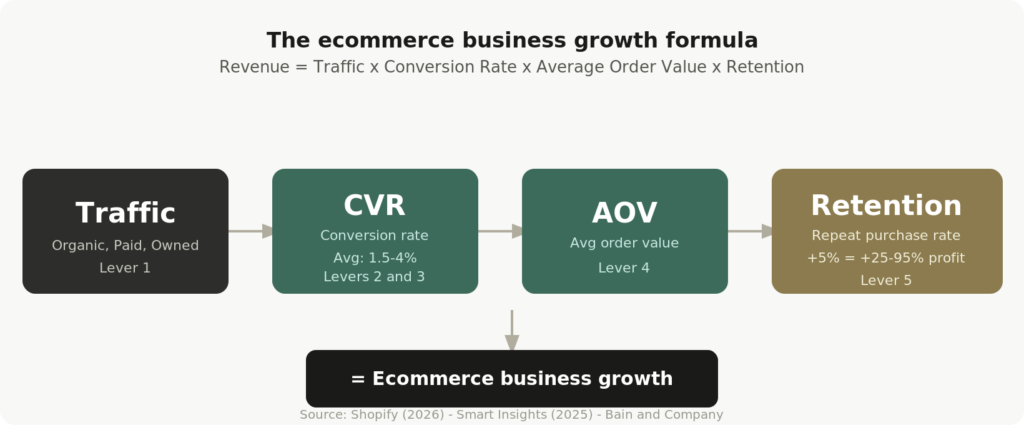
Repeat customers account for 48% of ecommerce transactions, and the average store retains only 31% of buyers. The lift is enormous: once a customer makes a second purchase, the probability of a third jumps from 27% to 54%. Retention is the only lever that compounds.
A minimum retention engine includes welcome and post-purchase email and SMS flows, a replenishment trigger for consumables, a winback flow at 60 and 120 days, and a VIP tier that surfaces the top 5% of customers. Lifecycle marketing is built before paid acquisition is scaled, never after.
Step 6: scale acquisition only on profitable channels
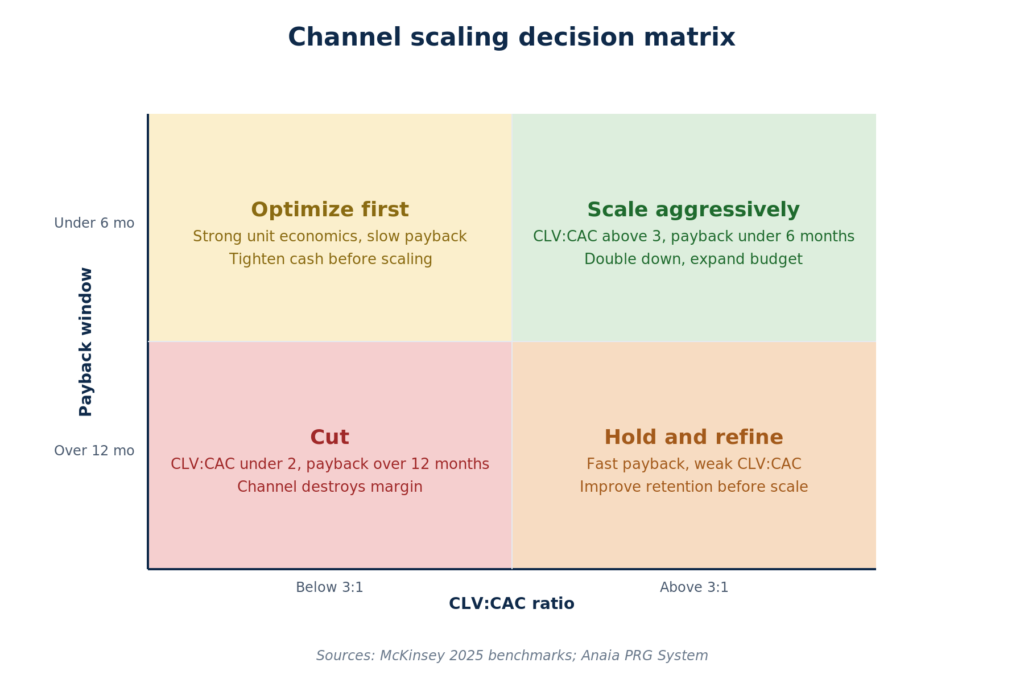
Once retention runs, paid acquisition can be scaled with confidence. The non-negotiable benchmark is a CLV:CAC ratio above 3:1, with payback inside 6 to 12 months. Channels below that ratio shrink rather than scale, regardless of how much budget the team is willing to allocate.
The right pacing is to test new channels with a fixed budget for 30 to 60 days, kill the ones that miss benchmark, and double down on the ones that exceed it. Scaling on a single proven channel is almost always more profitable than spreading budget across five marginal ones.
Step 7: expand to new channels and markets
Channel expansion comes last, never first. Brands that scale to 8-figure revenue almost always operate across at least three sales channels: their owned store, a major marketplace (Amazon, eBay, or a category-specific equivalent), and a wholesale or B2B layer. Geographic expansion follows the same rule.
The trap is sequencing. Adding Amazon, TikTok Shop, and a German store at the same time triples operational complexity without tripling output. Each new channel deserves its own 90-day ramp, with localized payments and fulfillment in market.
How to know which step is your real bottleneck
The bottleneck is rarely the step a founder is most enthusiastic about. It is the one that, if fixed, would unlock the most additional revenue per euro of work. The diagnostic is structured: 90 days of P&L and analytics, mapped against the seven-step sequence, with a single output: the constraint to fix this quarter.
A simple test: list the next three things the team plans to do, then calculate the revenue impact of each at realistic conversion. If two of three target the same step in the sequence, the team is over-investing in one layer and starving another. The bottleneck is almost always the step nobody wants to touch.
Metrics that signal scaling is working (and that it is not)
Five metrics tell the truth about whether a store is scaling or just growing. Revenue alone is the worst of them. Contribution margin per order, CLV:CAC ratio, repeat purchase rate, hours of manual work per 1,000 orders, and cash conversion cycle in days reveal whether the business is getting healthier or more fragile as it grows.
| Metric | Healthy scaling | Warning zone | Source |
|---|---|---|---|
| CLV:CAC ratio | ≥ 3:1 | < 2:1 | McKinsey, 2025 |
| Payback window | ≤ 6 months | > 12 months | Industry benchmark |
| Repeat purchase rate | ≥ 35% | < 25% | Rivo, 2026 |
| Contribution margin per order | Stable or rising | Declining | Internal P&L |
| Cash conversion cycle | < 30 days | > 60 days | Internal finance |
The combined signal matters more than any single metric. A store with healthy CLV:CAC but a 90-day cash conversion cycle will still hit a wall, because growth is funded by working capital that does not exist yet.
Common mistakes that destroy margins during scaling
The most expensive mistake is scaling acquisition before retention. Every euro spent acquiring a customer who never returns funds the next acquisition cycle for a competitor with a working lifecycle layer. The math is structurally unfavorable, and no creative or media buying can fix it.
The second mistake is hiring before automating. Adding a customer service rep instead of a triage workflow, a warehouse picker instead of a 3PL, a bookkeeper instead of accounting automation. Headcount creates a fixed cost; automation creates leverage. Brands that scale profitably default to automation and only add headcount where judgment is non-substitutable.
The third mistake is launching new channels before the current one is operationally clean. A store with messy inventory sync on its main channel will multiply that mess across every additional channel it adds. Fix one, then expand.
Read Anaia’s case studies here.
The bottom line on how to scale an ecommerce business
Scaling an ecommerce business is the discipline of growing revenue while operational cost and complexity grow more slowly. The brands that succeed at this transition do not have a louder marketing playbook than the ones that stall. They have a tighter sequence. They fix the cash conversion cycle before raising ad spend, automate fulfillment before launching a new channel, and build retention before pouring money into acquisition.
Most stalled scaling stories trace back to a sequencing error, not a tactical one. A store that ran ads before fixing conversion. A founder who hired a customer service team instead of installing a triage flow. A team that launched on Amazon while the main store still leaked basket abandonment at 75%. The tactics were not wrong; the order was. Scaling rewards the operator who knows which lever to pull first, and is willing to wait on the more exciting ones until the foundation holds.
The Anaia approach treats scaling as a structured engineering problem. Map the leaks, fix the largest one, install the operational layer, then invest aggressively only where the unit economics justify it. The brands that follow this sequence rarely need a turnaround later, because every step compounds the previous one. The ones that skip the sequence almost always need outside capital to survive the consequences.
The shortcut nobody mentions is also the most boring one: a finance, ops, and lifecycle baseline that lets paid acquisition do its job. Scale is built in the back of the business, not the front.
Scale on a foundation that holds, not on a hope that it does. Run the Anaia revenue growth diagnostic in 15 minutes and identify the operational constraint blocking your next scaling step.
FAQ
Q1 : What is the difference between growing and scaling an ecommerce business?
Growing means increasing revenue. Scaling means increasing revenue while cost and complexity grow more slowly. A store that doubles revenue by doubling team size and ad spend is growing. A store that doubles revenue while keeping headcount flat and improving margin is scaling. The two paths use different tactics and different sequences.
Q2 : When is an ecommerce business ready to scale?
An ecommerce business is ready to scale when conversion sits at or above benchmark (2.5% to 3% for most categories), repeat purchase rate is above 30%, CLV:CAC ratio is above 3:1, and the cash conversion cycle is under 60 days. If any of these is missing, scaling spend will accelerate the leak rather than the growth.
Q3 : How long does it take to scale an ecommerce business?
Scaling from 500k€ to 5M€ typically takes 18 to 36 months when the operational sequence is followed. Brands that try to compress the timeline by skipping retention or automation almost always stall around 2M€ and spend an additional 12 to 18 months recovering margin before they can scale again.
Q4 : What is the best CLV:CAC ratio for ecommerce scaling?
A CLV:CAC ratio above 3:1 is the minimum for sustainable scaling. Established ecommerce brands frequently operate between 4:1 and 6:1 on their best channels. Anything below 2:1 means the business is paying more to acquire a customer than that customer will return, and scaling spend will accelerate cash burn.
Q5 : Should an ecommerce store automate or hire to scale?
Automation comes first; headcount comes second. Repetitive tasks (order tagging, inventory sync, refunds, lifecycle emails, customer service triage) should always be automated before a hire is made. Headcount is reserved for judgment-heavy work: merchandising, brand, partnerships, finance. Brands that default to hiring create fixed cost without leverage.
Q6 : Which channel is best to scale ecommerce revenue?
The best channel is the one where the CLV:CAC ratio is already above 3:1 and the payback window is under 6 months. For most DTC brands that channel is a combination of branded search, Meta retargeting, and lifecycle email or SMS. Channels are added one at a time, never in parallel.

Founder & CEO of Anaia Marketing, Dominique doesn’t manage traffic. He builds systems that grow revenue, predictably, measurably, without guesswork. With 15+ years at the intersection of search strategy and editorial precision, he focuses on what matters : turning organic growth into a compounding asset that moves revenue.


Pingback: Ecommerce Growth: What It Takes to Scale Profitably in 2026
Pingback: Ecommerce growth tactics: 10 used by high-growth stores